
43. Henry Cavendish’s Clapham Observatory
20th January 2025
By Timothy M M Baker
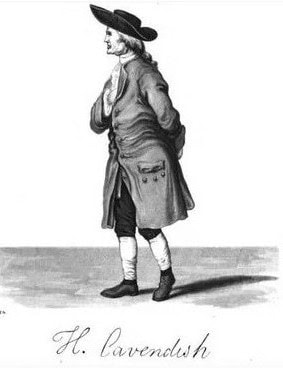
Derrick Johnson, in his 2018 article for the South London Press, also published in the Clapham Society’s Local History Series, ‘Eccentric Scientist Who Weighed the Earth’, has described how Henry Cavendish, a noted amateur scientist, lived in what became known as Cavendish House from the 1780s until his death in 1810. With its extensive gardens, the house stood at the south end of Clapham Common, close to the south corner of Dragmire Lane, now Cavendish Road, part of the South Circular Road. Englewood Road now runs directly across where the house stood, and down the garden which Gordon Stanley Maxwell recalled in his 1927 book Just Beyond London: Home Travellers’ Tales with Some Glimpses of Rus-in-sub-urbe:
‘I can vividly remember being told … that the world was weighed here … I distinctly remember climbing upon a table by the window to look down the long, well-wooded garden. The world to me was then summed up by a large globe we had in the schoolroom, and I fully expected, in the unreasoning faith and unbounded imagination of childhood, to see some kind of gigantic super-scales whereon this seeming miracle was performed.’[1]
In his 1851 biography of Cavendish, Henry Wilson stated that as well as the laboratories that filled much of the house, Cavendish also had an astronomical observatory in its upper rooms. Wilson’s source was Charles Tomlinson, whose informants were the then occupant of Cavendish house, and the Clapham physician Thomas Silvester.
Contemporary sources indicate that Cavendish also built a separate transit room in the garden of Cavendish House, which it appears played a role in two major achievements of Georgian science: William Roy’s geodetic triangulation of the London area in 1787, and Cavendish’s own famous experiment to ‘weigh the World’ in 1798-1799, the subject of Maxwell’s childhood fascination, which was described in Derrick Johnson’s 2018 article, and also in a detailed account by myself for the Society for the History of Astronomy’s Journal Antiquarian Astronomer in 2024.
Transit telescopes are used to determine the time at which, night after night, as the world turns, stars and other heavenly bodies ‘transit’ across the north-south meridian, the semicircle that arcs across the sky from the northern horizon, via the North Pole and the zenith, to the southern horizon. A transit telescope needs to be mounted very precisely so that it can be rotated from north to south around an east-west axis in order to reach all elevations from the horizon to the zenith. But it is fixed in ‘azimuth’, so it does not swing from east to west across the sky. The most famous of transit telescopes is George Airy’s Transit Circle at the Royal Observatory, Greenwich, which defined the Greenwich Meridian, internationally agreed in 1884 as the zero of longitude.
Aligned with the north-east to south-west road to Epsom, Cavendish House faced north-westwards across Clapham Common, and at the back south-eastwards down its long garden. So its attic would not have been well suited to house a transit telescope.
Batten’s 1827 plan of Clapham shows a rectangular outbuilding, oriented east-west, between Cavendish House and what was then Dragmire Lane and is now Cavendish Road. This was probably Cavendish’s Transit Observatory, its meridian stretching south across the garden and north across the Common.
Cavendish stated in his paper on the experiment to ‘weigh the World’ (in fact he was using a torsion balance to measure the density of the Earth) that he did so in a building oriented east-west, which he referred to in the same paper as ‘the Observatory’. Francis Baily stated in his 1842 paper on his repetition of Cavendish’s Experiment that Cavendish had worked in an outbuilding of Cavendish House. This evidence suggests that it was indeed the building shown on Batten’s plan.
In his 1790 paper on the Anglo-French geodetic triangulation between the Greenwich and Paris Observatories, in order to measure precisely their relative longitudes, William Roy also described his ‘secondary triangulation’ of the London area. This work was an early stage in the triangulation of the whole of Britain that underlay the Ordnance Survey’s accurate maps of the early nineteenth century. With his expertise in precise measurement, Cavendish had been closely involved in the project from the outset.
Cavendish’s ‘Transit Room’ at Clapham was one of the stations for Roy’s secondary triangulation. Roy determined its position by sighting from two of his primary triangulation stations, at Severndroog Castle on Shooters Hill, Kent (near Woolwich in the London Borough of Greenwich) to the east, and Hundred Acres, on Banstead Downs, Surrey to the south. Working at night, without the light pollution that arrived later with the spread of artificial illumination, Roy used bright lamps shining across miles of dark countryside, sighted using Jesse Ramsden’s unprecedentedly accurate telescopic ‘great theodolite’, to achieve great precision in the bearing of his stations over long distances.
Roy was thus able to compute the latitude and longitude of Cavendish’s Transit Room at Cavendish House very precisely at 51°27’12.7” N, 0°8’39.2” W: 24,563 feet and 6 inches from the dome of St Paul’s Cathedral in the City of London, on a south-south-westerly bearing of 206°29’52”. Taking account of the slight discrepancy between the Greenwich Meridian and the modern International Reference Meridian, Roy’s figures are consistent with the GPS coordinates today of the site of the outbuilding shown on Batten’s plan.
Most of Roy’s triangulation stations in the London area were either church steeples or prominent hilltops. The other observatories apart from Cavendish’s that he used perhaps give some idea of the prominence of Cavendish in the enterprise: the King’s Observatory at Richmond, Surrey (now Kew Observatory); the well known amateur astronomer Alexander Aubert’s successive observatories at Loampit Hill, Deptford, Kent, and Highbury House, Middlesex; and Roy’s own observatory at 12 Argyll Street, Westminster. Another station was Spring Grove, Isleworth, Middlesex, the country house of Sir Joseph Banks, President of the Royal Society.
In his 1798 paper on the experiment to ‘weigh the World’, Cavendish, referring to the building he had used, described a visit to ‘the Observatory’ by ‘M. Cassini’, presumably Jean-Dominique Cassini, the fourth and last of the Cassini dynasty who were directors of the Paris Observatory from 1671 to 1795. Cassini visited England in connection with the Greenwich-Paris triangulation. We may perhaps imagine other distinguished scientific visitors.
A further element of Cavendish’s observatory was a ship’s mast in the garden of Cavendish House, which he used in 1785 to test the lenses of an ‘aerial telescope’ given to the Royal Society by Christiaan Huygens in the late seventeenth century. James Edwards described it and Cavendish House in A Companion from London to Brighthelmston, in Sussex, 1801: ‘Opposite [the fifth milestone] is the seat of the Hon. Henry Cavendish. It is a tolerable good house, built with red brick. In a paddock at the back of the house is a mast of a ship, erected for the purpose of making philosophical experiments.’ Perhaps it was placed across the garden from the transit room to function as a meridian mark.
There is no record of Cavendish’s historic transit room after Batten’s 1827 map. The 1874 25-inch Ordnance Survey map shows that by that time it had been demolished, and was probably long gone. Its site is somewhere around where 4 Cavendish Road now stands.
Bibliography
Baily, Francis, ‘An Account of Some Experiments with the Torsion-rod, for Determining the Mean Density of the Earth’, Monthly Notices of the Royal Astronomical Society, 5, 24 (1842),
197-206; and Memoirs of the Royal Astronomical Society, 14 (1843).
Baker, Timothy M.M., ‘Clapham Common Constants: Henry Cavendish, James Clerk Maxwell, and the History of Gravitation and the Speed of Light’, Antiquarian Astronomer, 2024.
Cavendish, Henry, ‘Experiments to Determine the Density of the Earth’, Philosophical Transactions of the Royal Society of London, 88 (1798), 469-526.
Jungnickel, Christa, and McCormmach, Russell, Cavendish, The Experimental Life, 1999.
Roy, William, An Account of the trigonometrical operation, whereby the distance between the meridians of the observatories of Greenwich and Paris has been determined, 1790.
Wilson, George, The Life of the Hon. Henry Cavendish, 1851.
[1] Just Beyond London: Home Travellers’ Tales with Some Glimpses of Rus-in-sub-urbe, Gordon S Maxwell, 1927.